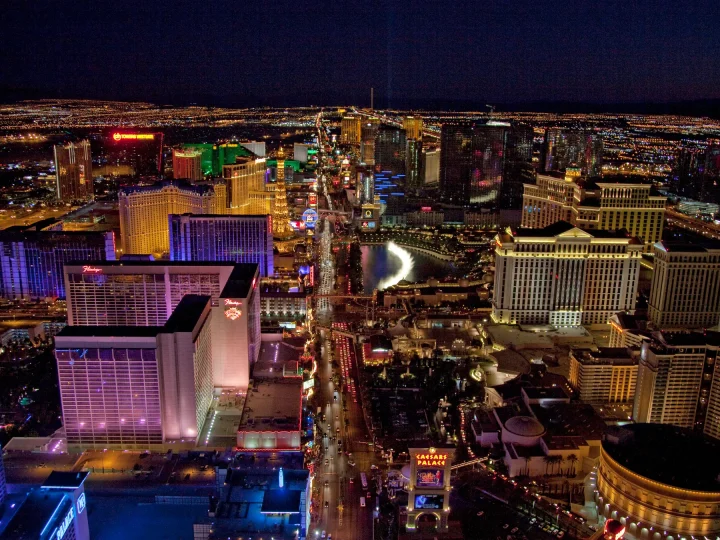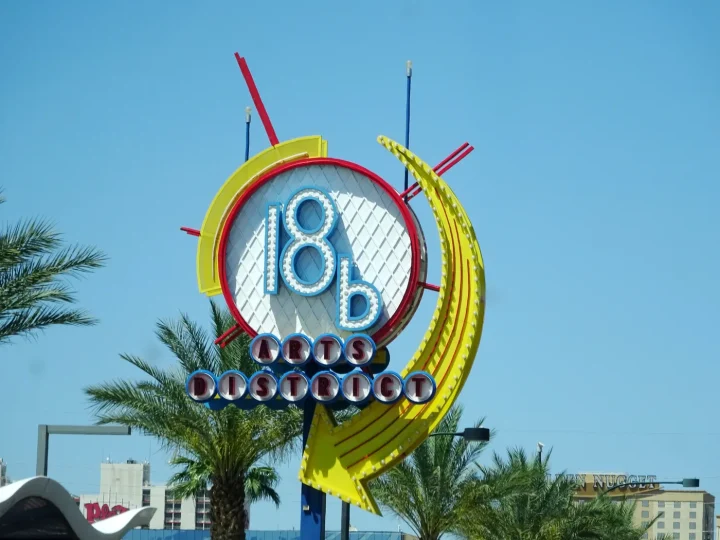
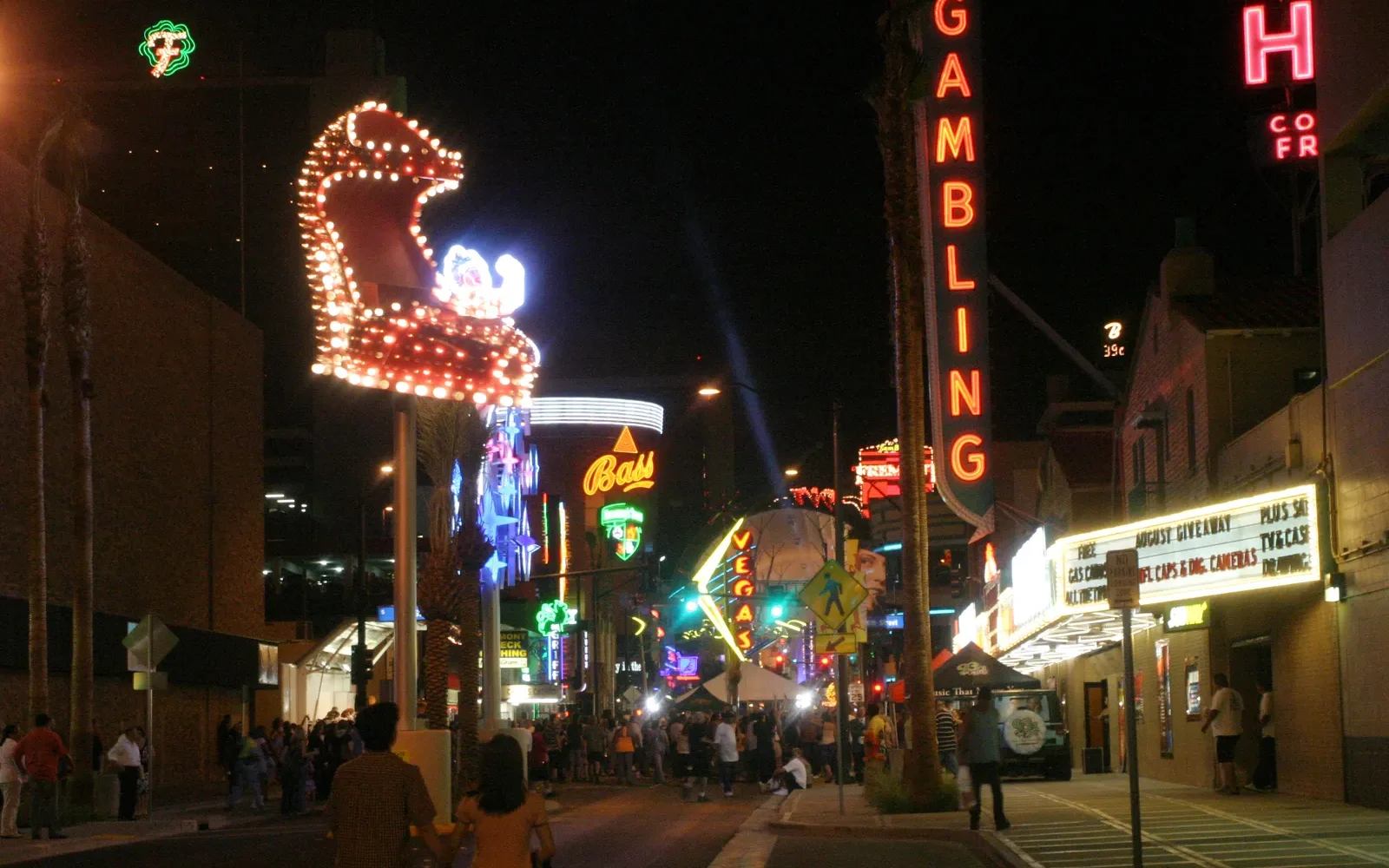
Downtown Las Vegas works best as a sequence of street-scale chapters: civic history and museums, Fremont’s changing signscape, Fremont East, and the creative businesses of the 18b Arts District.
Begin before the lights dominate
Starting in daylight makes Downtown easier to read. Low commercial buildings, restored facades, sign supports, murals, theaters, and mountain views remain visible before illumination becomes the main subject. Choose an opening museum, cultural venue, or architectural point and verify its current access directly. The goal is to build context, not collect a fixed sequence of attractions.

Big Bus Las Vegas: Sightseeing Night Tour by Open-Top Bus
Hop aboard the Big Bus Las Vegas Night Tour for the ultimate open-top adventure through Sin City’s dazzling lights! As the sun sets, watch the Strip...

Flyover in Las Vegas: An Immersive Flying Ride Experience
Experience the thrill of flight at Flyover in Las Vegas, where cutting-edge technology immerses you in breathtaking global destinations. Soar over ico...
Distances can look compact, but heat, road crossings, construction, and time inside a museum matter. Use a map that reflects the current pedestrian environment. Keep water, shade, accessibility, and a return plan in the route, especially when daylight transitions into a long evening.
Read Fremont as working design
Fremont Street is more useful than a single postcard. Look at the relationship between signs and buildings, the scale of lettering, repaired metal, bulb housings, and how older motifs sit beside contemporary screens and events. A preservation collection or interpreted museum visit can add the names, makers, and histories that a street photograph cannot supply.
Stay aware that commercial signs and properties have owners and rules. Photograph from lawful public space, avoid blocking movement, and do not treat workers or visitors as props. If a sign or interior is the reason for a visit, confirm that it is currently visible rather than relying on an old image.
Continue into Fremont East
Fremont East brings a smaller-grained mix of restaurants, bars, entertainment, and retro-scaled street elements. It can be a practical place to pause between a museum-heavy afternoon and a brighter evening. Choose food by current menu, accessibility, and the day’s geography instead of a permanent “best” ranking.
Give 18b time to be a neighborhood
The Arts District is not a mural drive-by. Studios, galleries, vintage shops, performance spaces, breweries, cafes, and restaurants open on their own rhythms. Check the district or individual businesses for current information, then leave room for a space that was not on the plan. Daylight is especially useful for storefront detail and a calmer view of adaptive reuse.
- Choose two anchors rather than scripting every block.
- Keep a weather and hydration plan.
- Respect artwork, private property, and photography policies.
- Use rides or transit when the return walk no longer fits the group.
- Verify event streets and pickup points before the evening.
Use a flexible sequence
A practical Downtown sequence might begin with an interpreted indoor stop, continue through older commercial streets, pause for food, then move toward Fremont East or 18b as the light changes. The sequence matters more than a fixed list. Keeping adjacent stops together reduces repeated crossings and gives the district time to reveal the contrast between ordinary daytime surfaces and illuminated night design.
Check event calendars because a festival, concert, street closure, or major gathering can change both atmosphere and movement. That may be a reason to visit, but it may also alter parking, transit, accessibility, and pickup locations. Build a backup meeting point that is easy to describe without depending on a temporary sign or crowded entrance.
Notice the city between attractions
The strongest Downtown details are often connective: a restored facade beside a new residential building, shade falling across a service alley, the visible structure behind a neon face, or a theater district opening toward a civic space. These observations keep the walk from becoming a row of isolated photo stops. They also make it easier to understand why Downtown and the Strip should not be used as interchangeable geographic labels.
End while the route still works for the group. Brightness, sound, heat, alcohol, crowds, and long standing periods can change judgment and pace. Confirm the return option before fatigue decides it for you, and keep the final block close enough that skipping it remains an easy choice.
For a trip-wide structure that connects Downtown to the Strip and desert edge, continue with Las Vegas beyond the marquee.

Award-Winning Lower Antelope Canyon, Horseshoe Bend 1-Day W/Wi-Fi
Experience one of Las Vegas' most trusted day tours to Lower Antelope Canyon and Horseshoe Bend. Proudly recognized...

Award Winning 3-Hour Hoover Dam Small Group Mini Tour from Vegas
The Hoover Dam Mini Tour - a three-time winner of Viator's "Experience Award," showcasing the world's best tours, is...

Antelope Canyon & Horseshoe Bend Day Tour with Lunch, Free WiFi
Step into the surreal beauty of Antelope Canyon, where narrow sandstone walls twist and glow with vibrant hues of re...
Big Bus Las Vegas: Sightseeing Night Tour by Open-Top Bus
Hop aboard the Big Bus Las Vegas Night Tour for the ultimate open-top adventure through Sin City’s dazzling lights! As the sun sets, watch the Strip...
Flyover in Las Vegas: An Immersive Flying Ride Experience
Experience the thrill of flight at Flyover in Las Vegas, where cutting-edge technology immerses you in breathtaking...
Award Winning 3-Hour Hoover Dam Small Group Mini Tour from Vegas
The Hoover Dam Mini Tour - a three-time winner of Viator's "Experience Award," showcasing the world's best tours, is...
Still comparing Downtown Las Vegas Walking Itinerary?
Ask for tour ideas, hotel suggestions, or a simple trip plan that combines both.